
For over two decades, digital marketing ran on a straightforward value exchange: search engines organized the world’s information, listed ten blue links, and sent curious users straight to your website.
That model is officially broken.
With Google AI Overviews triggering on nearly half of all search queries, alongside hundreds of millions of weekly active users turning to ChatGPT, Perplexity, and Claude for direct answers, web search has reached an inflection point. Recent industry benchmarks indicate that up to 69% of web searches now end without a single click-through.
When Large Language Models (LLMs) synthesize multi-source answers right inside the search interface, users get what they need immediately. The click isn’t just dying—for simple informational queries, it’s already gone.
If your organic growth playbook relies strictly on targeting long-tail keywords, writing 2,000-word fluff-filled guides, and hunting for standard backlinks, your traffic is heading for a cliff. Welcome to the era of Generative Engine Optimization (GEO)—the discipline of engineering your brand’s digital footprint so LLMs cite, reference, and recommend you as an undeniable authority.
Here is your tactical, step-by-step framework to transition from SEO to GEO and secure your position inside AI-generated answers.
The Paradigm Shift: SEO vs. GEO
To win in generative search, you must first understand how LLM retrieval differs from traditional web indexing.
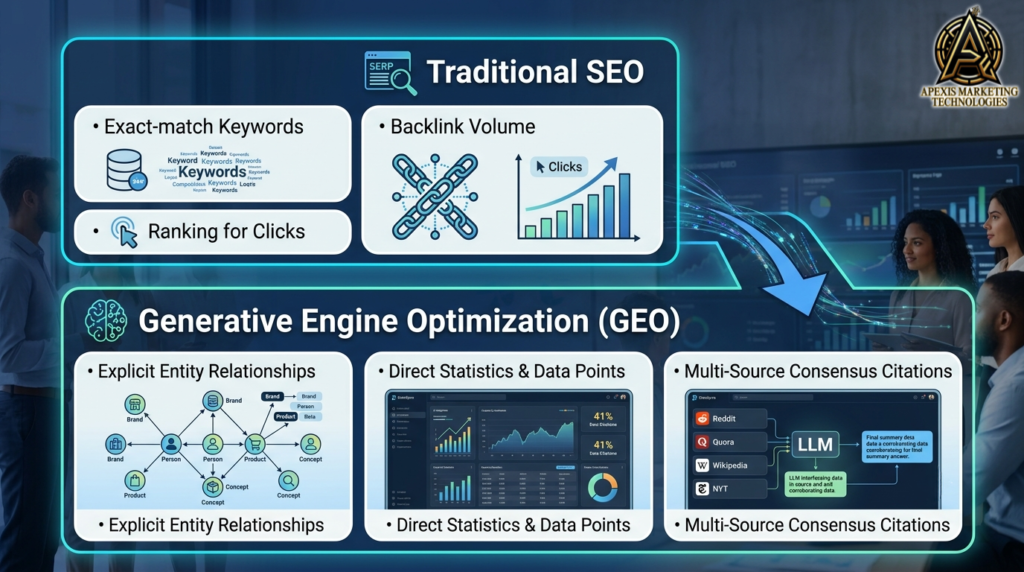
- Traditional Search Engines (SEO): Match user search terms to relevant web pages using keyword density, site structure, and domain authority via backlink profiles. The goal is to drive web traffic to an external landing page.
- Generative Engines (GEO): Deconstruct a user’s prompt into sub-queries, parse millions of data points across the web, evaluate entity trust, and synthesize a single, cohesive answer. The goal is to solve the prompt in real time, citing only the most authoritative sources.
In short: SEO optimizes for clicks; GEO optimizes for citations and brand presence.
The 4-Pillar GEO Execution Framework
Ready to update your content architecture? Implementing these four core pillars will help ensure LLMs recognize, trust, and quote your content.
1. Anchor Content with Hard Statistics and Data Points
Generative engines love verifiable facts. Empirical research from Princeton and Georgia Tech revealed that adding direct statistics and numerical data to content is one of the single most effective GEO tactics, boosting a brand’s inclusion in AI-generated answers by up to 41%.
How to Execute:
- Publish Proprietary Benchmarks: Conduct original surveys, analyze internal product data, or run industry studies.
- Lead with the Data: Place your key statistical findings in the first 30% of your article or guide. LLM parsing algorithms heavily weigh lead paragraphs when scraping for summary answers.
- Format for Extraction: Use clear blockquotes, summary callout boxes, and simple HTML tables.
GEO Rule of Thumb: Never write “Many companies use AI in marketing.” Write “According to our 2026 enterprise study, 72% of marketing teams actively deploy AI in production workflows.”
2. Implement Explicit Entity Markup & Schema
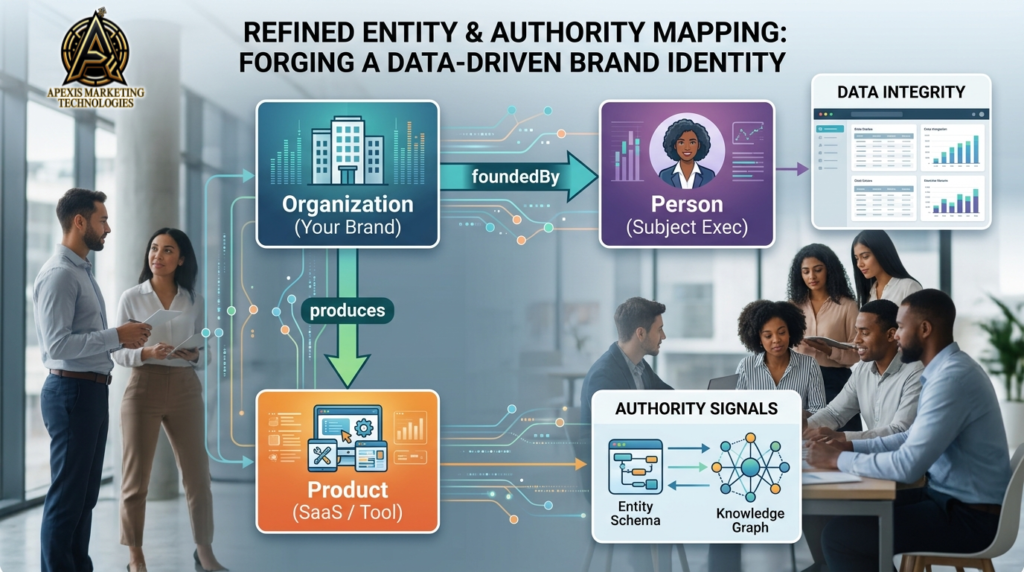
LLMs do not view the web as a collection of text strings; they process it as a web of entities (people, places, organizations, concepts) and the relationships between them. If an AI model cannot clearly define what your company does and who your experts are, it will bypass your brand.
How to Execute:
- Leverage Advanced Schema.org Markup: Do not stop at basic Article schema. Implement robust Organization, Product, Person (Author), and SameAs schema properties.
- Link External Identifiers: Use SameAs tags in your JSON-LD code to map your brand directly to your Wikidata entries, official social profiles, Crunchbase pages, and industry review profiles (G2, Capterra).
- Maintain Niche Glossary Architecture: Create dedicated entity pages explaining industry terms, frameworks, and methodologies proprietary to your brand.
3. Build Multi-Source Consensus (Off-Page GEO)
Here is a counter-intuitive truth about AI search: up to 82% of AI citations come from earned media, third-party discussions, and unlinked brand mentions—not your own domain. Generative models check for consensus across the web before stating a claim.
How to Execute:
- Dominate Third-Party Aggregators: AI models heavily favor Reddit, Quora, YouTube, Wikipedia, and specialized review platforms when synthesizing buyer recommendations. Ensure active, authentic participation in subreddits relevant to your vertical.
- Digital PR for Co-Occurring Mentions: Focus digital PR efforts on getting your brand named alongside industry category leaders in roundups, news articles, and expert roundtables.
- Encourage Executive Thought Leadership: When your C-suite publishes podcasts, quotes in major trade journals, and articles on LinkedIn, LLMs register those statements as authoritative brand signals.
4. Optimize Content Structure for “Fan-Out” Queries
When a user inputs a complex question like “What is the best enterprise CRM for a mid-sized healthcare company?”, an LLM executes a fan-out query. It breaks that single prompt into several underlying sub-questions:
- What are the top CRMs for mid-market businesses?
- Which CRMs are HIPAA compliant?
- What are the implementation costs for healthcare CRMs?
How to Execute:
- Answer Questions Direct-First: Use clear H2/H3 headers for sub-questions. Provide a direct 1-to-2 sentence answer immediately following the heading, followed by detailed bullet points.
- Provide Complete Topic Coverage: Rather than writing one surface-level piece, build comprehensive topic clusters that answer every adjacent sub-question thoroughly.
- Add Quotations and Expert Citations: Including authoritative quotes and explicit source citations improves LLM confidence scores when parsing content for accuracy.
Measuring GEO Success: The New Metrics
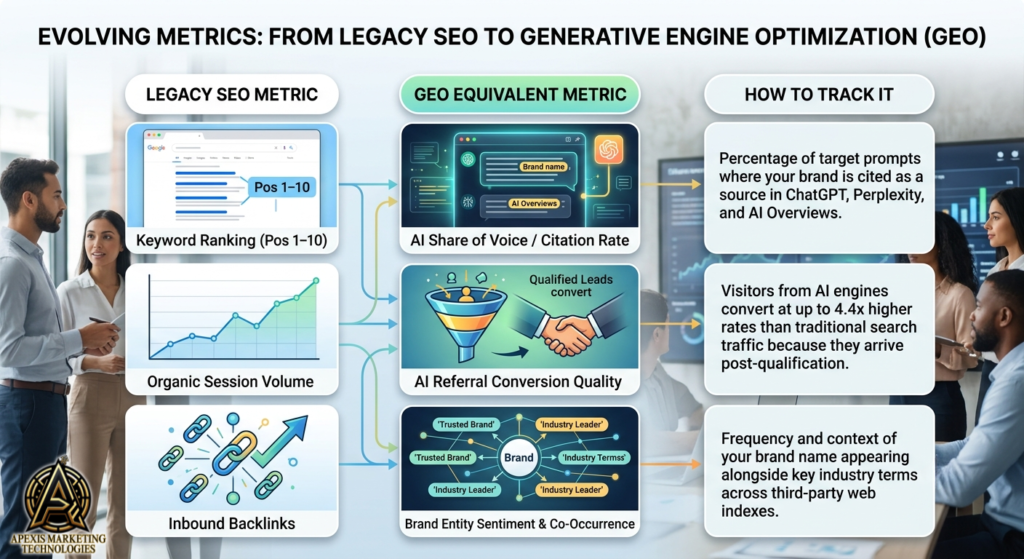
You cannot measure Generative Engine Optimization using legacy Google Search Console impressions or organic click-through rates. To track your GEO maturity, focus on these three evolving metrics:
Conclusion: The Path Forward for Modern Marketers
The shift from SEO to GEO isn’t a death sentence for organic marketing—it’s a flight to quality. While zero-click search means top-of-funnel impression traffic will decline, the users who do click through from an AI summary are far further down the funnel, better informed, and ready to buy.
Key Action Plan for the Next 90 Days:
- Audit your top 20 performing articles: Add direct data points, original statistics, and clear direct-answer formatting.
- Upgrade your Schema JSON-LD markup to explicitly map your brand, products, and key executives to external entity registries.
- Expand digital PR beyond backlink building—focus on driving authentic brand consensus across Reddit, industry reviews, and earned media publications.
Stop writing for algorithms that count keywords. Start structuring knowledge for engines that synthesize answers.