

The internet changed while we were busy managing our businesses.
For decades, the path to finding anything online was entirely predictable. You opened a web browser, typed a phrase into a blank box, and scrolled through ten blue links. If you ran a small business, your digital survival strategy depended on ranking at the top of that specific list.
Not anymore.
Today, consumers are completely bypassing traditional search engines. When people want to find a new restaurant, a reliable contractor, software, or an explanation of a complex topic, they don’t just “Google it.” They open TikTok, Instagram, YouTube, or Reddit. They type questions directly into social feeds because they want to see real people giving real answers in real time.
Social media has officially become the new search engine. For small businesses and entrepreneurs, this represents the single biggest shift in digital discovery in a generation. If your marketing strategy still treats social networks as places just to post pretty pictures, you are missing the exact moments your future customers are actively looking for you.
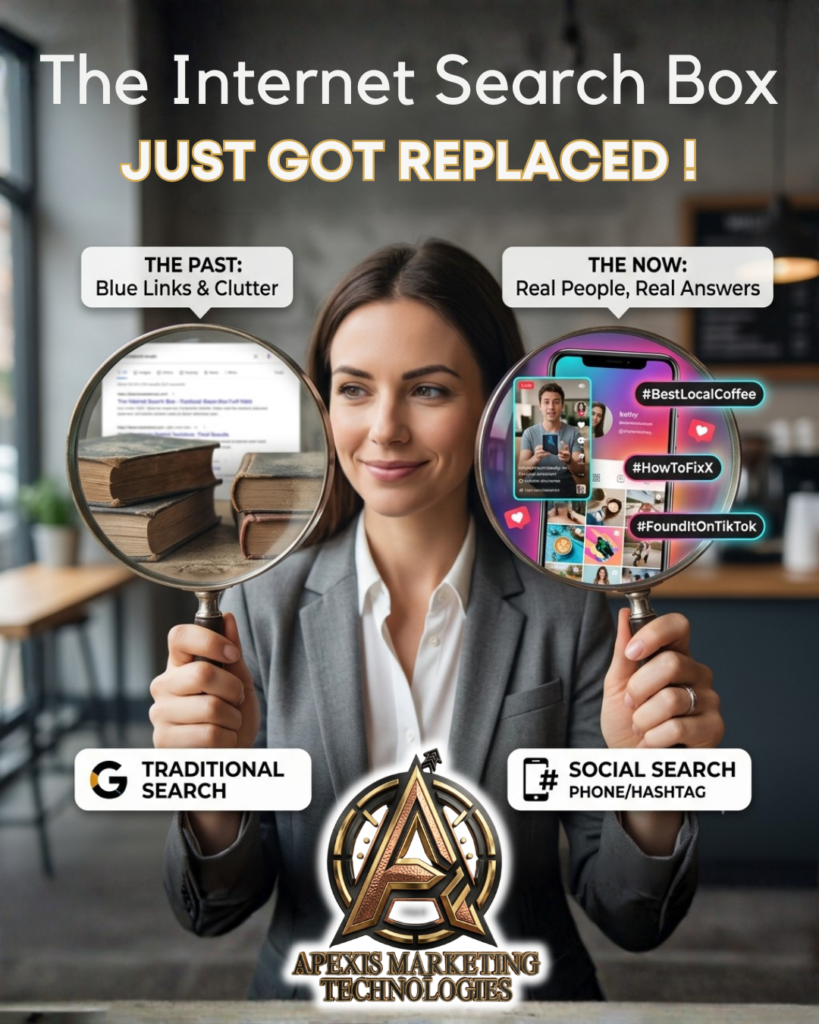
The Reality of Social Search
This change isn’t a temporary trend or a niche habit confined to teenagers. It is a fundamental rewiring of how human beings look for information online. The data proves exactly how fast the ground is shifting:
- The Generational Pivot: Industry data shows that 46% of Gen Z consumers and 35% of Millennials actively prefer searching on social media platforms over traditional search engines.
- Mass Adoption: Studies reveal that nearly half of all U.S. consumers have used TikTok specifically as a search engine to find information, products, or local services.
- The Trust Factor: Over half of social media users prefer social search because they want user-generated content and personal experiences. They want to see a product in someone’s hands, not just read a polished sales page.
Traditional search engines have a massive structural problem: they feel corporate, cluttered with ads, and sterile. When a user searches for something on a traditional engine, the first few results are paid advertisements, followed by articles engineered by massive corporations to satisfy an algorithm.
Social search wins because it delivers instant human proof. People trust people who share their specific context. A contractor looking for a rugged tool belt wants to see it tested on an actual job site by another tradesperson. Social platforms organize information by community, making the answers feel highly tailored and relevant to the user’s life.
Why Consumers Are Ditching the Traditional Search Box
To win at social search, you have to understand why people are making the switch. Traditional search engines have a massive structural problem: they feel increasingly corporate, cluttered with ads, and sterile.
When a user searches for something on a traditional search engine, the first four results are usually paid advertisements. Below that are articles specifically engineered by massive corporations to satisfy an algorithm, often filled with thousands of words of fluff just to rank higher.
Social search wins because it delivers three things traditional platforms struggle to provide:
1. Instant Human Proof
If you are looking for a weekend getaway spot, would you rather read a text-heavy travel blog written by an anonymous copywriter, or watch a 30-second video of an actual traveler walking through the boutique hotel room, showing the view from the balcony, and giving a raw review of the breakfast? Social media provides immediate visual and emotional proof. It feels honest.
2. Micro-Communities and Shared Identity
People trust people who share their specific context. A parent looking for toddler shoes wants recommendations from other parents dealing with the exact same daily struggles. A contractor looking for a rugged tool belt wants to see it tested on an actual job site by another tradesperson. Social platforms organize information by community, making the answers feel highly tailored and relevant to the user’s life.
3. Dynamic Multi-Sensory Answers
Traditional text search is flat. Social search is three-dimensional. It combines audio, text overlay, video demonstrations, and a live comment section where other users openly debate the merits of the content. The comment section itself acts as a secondary layer of crowdsourced search verification.
Traditional SEO vs. Social SEO: The New Playbook
Because the search environment has evolved, the rules of search engine optimization (SEO) have changed too. You can no longer rely solely on the old rules of website optimization. You need to apply search principles directly to your social media profiles.

How to Optimize Your Business for Social Search
Transitioning your business to thrive in this new landscape requires a shift in perspective. You have to stop viewing social media posts as disposable pieces of daily content and start viewing them as permanent search assets.
1. Build a Search-Optimized Profile Bio
Your profile page is your digital storefront. When someone lands on your profile after a search, they need to know exactly who you are, what you do, and who you serve within three seconds. Ditch the cryptic, clever, or overly vague taglines. Use clear, searchable words in your name field and bio. If you are a graphic designer in Austin, Texas, your name field shouldn’t just say “Sarah Creative.” It should say “Sarah | Austin Graphic Designer.”
2. Treat Captions Like Mini Blog Posts
The algorithms powering social platforms scan text closely to categorize your content. Write descriptive, keyword-rich captions using natural language to explain exactly what your video or image covers. If you are sharing a quick tutorial on business budgeting, make sure phrases like “how to manage small business cash flow” or “easy business budgeting tips” appear naturally in your text.
3. Optimize for the Ears and the Eyes
Modern social algorithms do not just read text; they listen to your audio and read the visual elements inside your videos. When you create video content, say your primary keywords out loud within the first five seconds. Use the platform’s native text tool to add on-screen captions and titles that explicitly state the topic.
4. Focus on “Saves” and “Shares”
In social search, user engagement acts as your primary authority signal. Specifically, saves and shares carry massive weight. When a user saves your post, they tell the algorithm the information is highly valuable. Design your content to be saved by creating checklists, step-by-step guides, and clear strategies that make viewers think, I need to keep this for later.
Platform Strategies at a Glance
Every social network operates with a slightly different search dynamic. To get the best return on your marketing investment, tailor your approach to match user expectations on each channel.
- TikTok: The hub for quick, raw, authentic answers to practical questions. Users look for product reviews and tutorial guides. Focus on creating content that answers highly specific questions, like “The exact spreadsheets I use to track my business expenses.”
- Instagram: Heavily utilized for lifestyle, aesthetic inspiration, and local business discovery. Use location tags consistently if you serve a specific geographic region, and use crisp carousels that break down complex topics into digestible slides.
- YouTube: The second largest search engine in the world. People visit YouTube when they want a comprehensive, deep understanding of a subject. Invest in high-quality educational content, structure your titles around specific search phrases, and use timestamps.
Scaling Your Small Business with the Right Partner
Navigating this rapidly evolving digital ecosystem can feel incredibly overwhelming when you are also trying to run the day-to-day operations of your business. You have to manage inventory, handle client fulfillment, lead teams, and somehow find the time to keep up with changing social algorithms and search mechanics.
That is where we come in. Apexis Marketing Technologies is an expert in helping small businesses scale and developing comprehensive marketing strategies that deliver sustainable, long-term results.
The shift toward social search isn’t a threat to your small business—it is a massive competitive advantage if you choose to act on it before your competitors do. By intentionally treating your social media channels as engines of discovery, you can build a consistent stream of inbound clients who are already looking for the exact solutions you provide.