Spreading your business across every social media platform leads to burnout and zero ROI. Learn why a focused social strategy drives higher conversions, better data, and real business growth.
You’ve likely felt the subtle (or screaming) pressure.
A consultant tells you your brand must be on TikTok. An article claims Pinterest is booming for B2B. A podcast host insists that if you aren’t posting on LinkedIn three times a day while simultaneously building out Threads and hosting live audio spaces, you’re already irrelevantly outdated.
So, you open 14 browser tabs, fire up a design tool, and try to script a short-form video while writing a long-form thought leadership piece. Two hours later, you’re exhausted, your real work hasn’t been touched, and your latest post has three likes—two of which are from your team members.
Here is the inconvenient truth most agencies won’t tell you: trying to dominate every single social media platform isn’t multi-channel marketing—it’s operational sabotage.
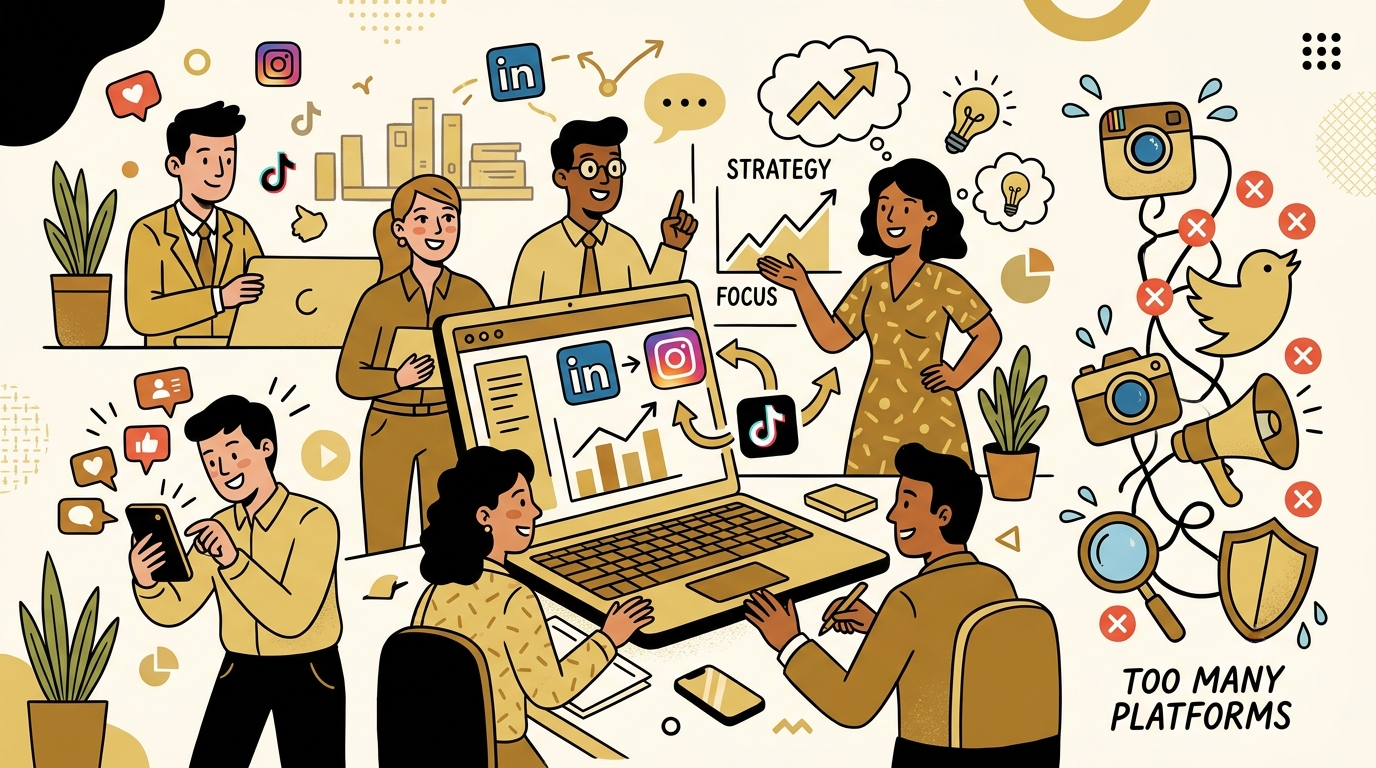
Spreading your bandwidth across six different channels doesn’t make your business look ubiquitous; it just makes your strategy look diluted. When it comes to digital media execution, less isn’t just more—it’s profitable.
Here is why drowning in social channels is strangling your organic growth, and how a targeted, channel-exclusive strategy can turn your marketing into a high-converting machine.
1. The Multi-Platform Trap: High Effort, Zero Depth
The promise of omnichannel presence sounds great on paper: “If we show up everywhere, our ideal customers are bound to see us.”
In reality, algorithm design and user behavior work completely against this shotgun approach.
Quantity Dilutes Conversion Rates
When you force yourself to publish across four, five, or six networks daily, quality isn’t just compromised—it’s eradicated. Instead of crafting one high-intent piece of content that addresses a specific pain point and guides readers toward a logical next step, you end up churning out surface-level filler just to satisfy a calendar grid.
The Reality: One deeply resonant, well-researched post on the right platform will generate more qualified leads than twenty rushed, generic updates scattered across five ghost towns.
Algorithm Nuance and User Context
Every platform operates under its own distinct cultural language, content mechanics, and algorithmic signals:
- LinkedIn rewards structured text, zero-click value, and professional narrative framing.
- TikTok & Reels require fast-paced hooks, dynamic visual retention, and native audio trends.
- Pinterest acts as a visual search engine where user intent is focused on planning and curation, not conversation.
Cross-posting the exact same graphic or caption across all three ignores why people log onto those platforms in the first place. When content feels out of place, users scroll past—and platform algorithms penalize low engagement by throttling your future reach.
2. Resource Exhaustion: The Opportunity Cost of Social Noise
For executives and busy professionals, time is a finite resource with a clear hourly value. Every minute spent fighting an unfamiliar algorithm is a minute stolen from core operations, high-converting channels, or direct client deliverables.

The Misleading Nature of “Free” Organic Social
Organic social media is often labeled as “free” marketing, but calculating the internal labor cost reveals the true expense:
- Scripting, Filming, and Editing: ~3–5 hours per short-form video.
- Copywriting and Formatting: ~1–2 hours per platform-specific post.
- Community Management: ~30 minutes daily per platform monitoring comments and DMs.
If an executive or lead manager spends 15 hours a week managing five social profiles, that isn’t free marketing. That is a massive operational drain that could be directed toward search engine optimization (SEO), targeted email workflows, strategic partnerships, or client retention.
Diverting Focus to High-ROI Channels
Social media is merely one distribution pillar in a balanced marketing engine. When you pull back from social overload, you reclaim capacity to invest in foundational digital assets:
- Search Engine Optimization (SEO): Building evergreen website content that attracts high-intent organic traffic for years, not hours.
- Email Nurture Sequences: Owning your audience directly rather than renting space from an algorithm.
- Conversion Rate Optimization (CRO): Ensuring that when traffic actually hits your site, it converts.
3. Demographics and Intent: Meeting Your Market Where They Decide
A common mistake in modern content strategy is failing to differentiate between where people spend leisure time and where people make purchasing decisions.

4. Analytical Paralysis: Why Fewer Channels Yield Better Data
Data-driven marketing only works if you have the operational space to analyze the data and implement changes.

The Noise of Fragmented Metrics
Tracking reach, impressions, click-through rates, save ratios, and follower growth across five unique dashboard interfaces creates an overwhelming volume of noise. When metrics are scattered, busy professionals tend to skim vanity metrics (like total impressions) rather than evaluating conversion metrics (like link clicks and form fills).
Streamlining to Clean Insights
By focusing on one or two key channels, your analytical framework simplifies significantly:
- Faster Feedback Loops: You can quickly correlate a spike in website traffic to a specific post style or topic.
- Agile Adjustments: Instead of spending hours gathering multi-platform reports, you can test a new messaging angle on Monday and refine it by Thursday based on clear engagement data.
- Algorithm Mastery: Understanding the mechanics, updates, and best practices of one platform deeply is infinitely more valuable than having surface-level knowledge of five.
5. The Strategic Playbook: How to Transition to a Focused Model
Transitioning from a scattered presence to a lean, high-performing social strategy doesn’t mean abandoning your brand presence. It means restructuring for efficiency and ROI.
Step 1: Secure Your Brand Footprint (Park & Direct)
You don’t need to delete your secondary profiles. Maintain your brand safety by keeping accounts registered on major channels. However, optimize those profiles to direct visitors to your primary hub:
Example Bio for Inactive Profile: “We share our daily insights and active updates exclusively on LinkedIn. Follow us there [Link] or visit our website for resources [Link].”
Step 2: Implement a Core Content Framework
Instead of creating original content for every outlet, build a sustainable workflow centered around one primary platform:
- Create One Pillar Asset: Draft a comprehensive blog post, whitepaper, or detailed video analysis once a week.
- Extract Native Insights: Pull 2–3 actionable insights from that main asset specifically tailored for your primary social network.
- Drive Intent Back to Base: Ensure every post offers clear value while maintaining a direct path back to your website or email list.
Step 3: Establish Clear KPIs
Stop measuring success by how many posts went live this week. Track outcomes that reflect actual business health:
- Primary Social Metric: Qualified inbound messages, profile link clicks, and post save rates.
- Business Outcome Metric: High-intent website visitors generated and secondary leads added to your funnel.
Stop Guessing and Build a High-Converting Strategy
Finding the balance between consistent brand visibility and unsustainable marketing overhead isn’t easy. But trying to be everywhere at once isn’t a strategy—it’s a distraction from real business growth.
At Apexis Marketing Technologies, we help growth-focused brands cut through the digital noise. Instead of spreading your resources thin with generic, cross-posted filler, we build tailored, high-converting social media strategies designed specifically for where your high-intent audience actually pays attention.
Whether you need a streamlined baseline strategy or a fully managed, channel-exclusive content engine, we offer flexible execution plans tailored to your specific business goals and operational structure.
Ready to stop chasing algorithms and start driving real revenue? Visit www.apexismarketing.net today to schedule a strategic consultation, and let’s build a focused marketing model that actually moves the needle.